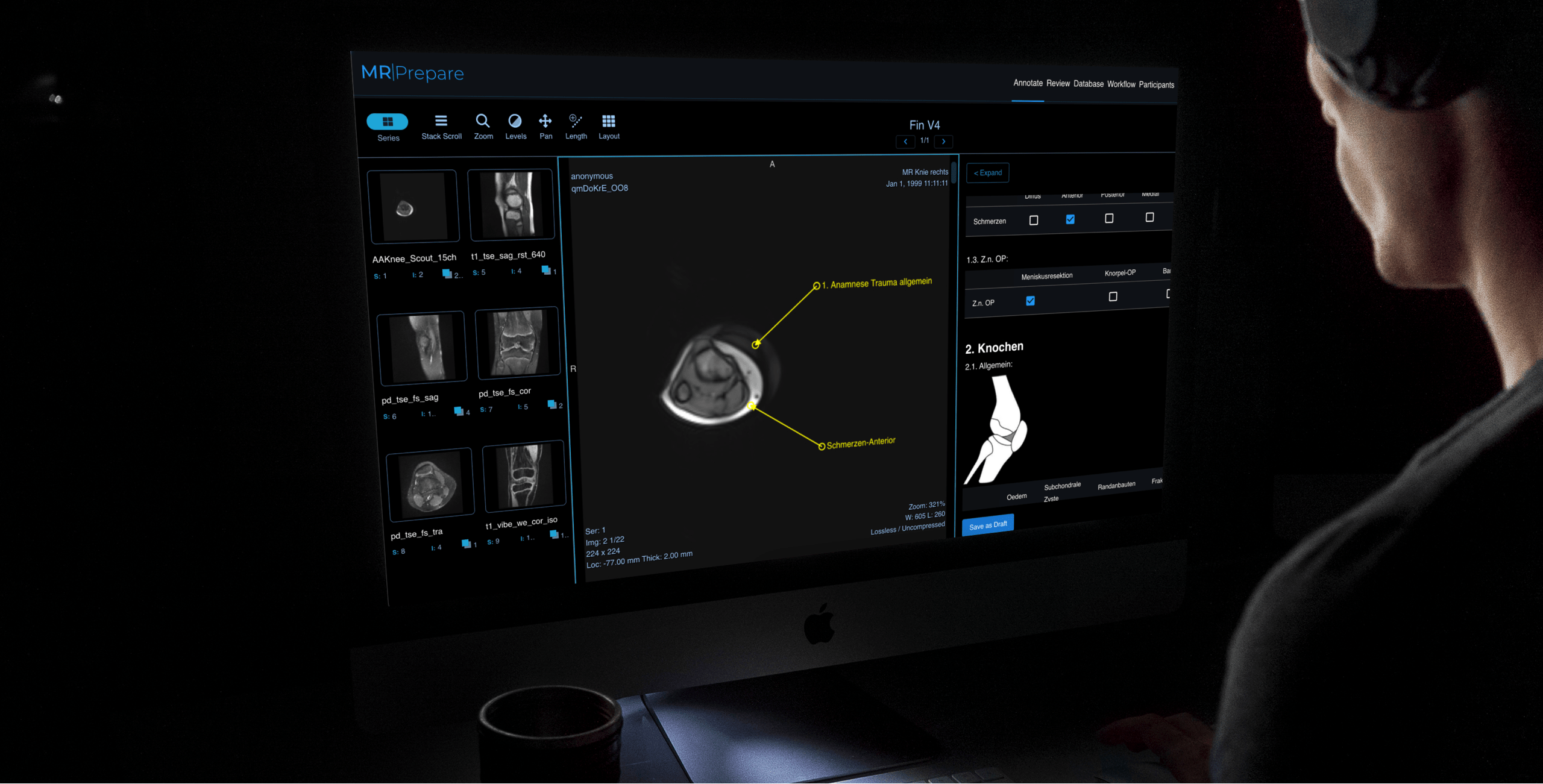
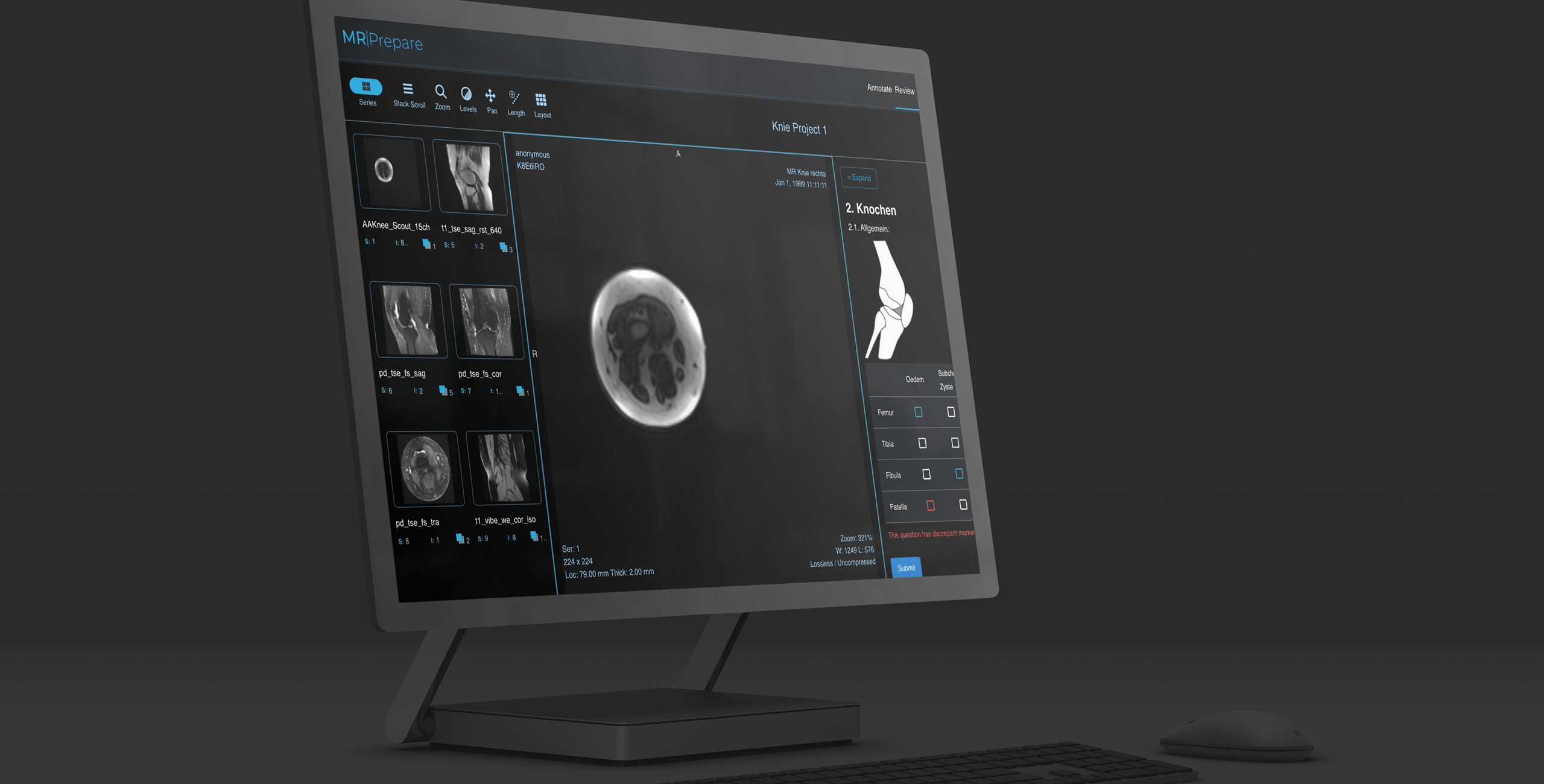
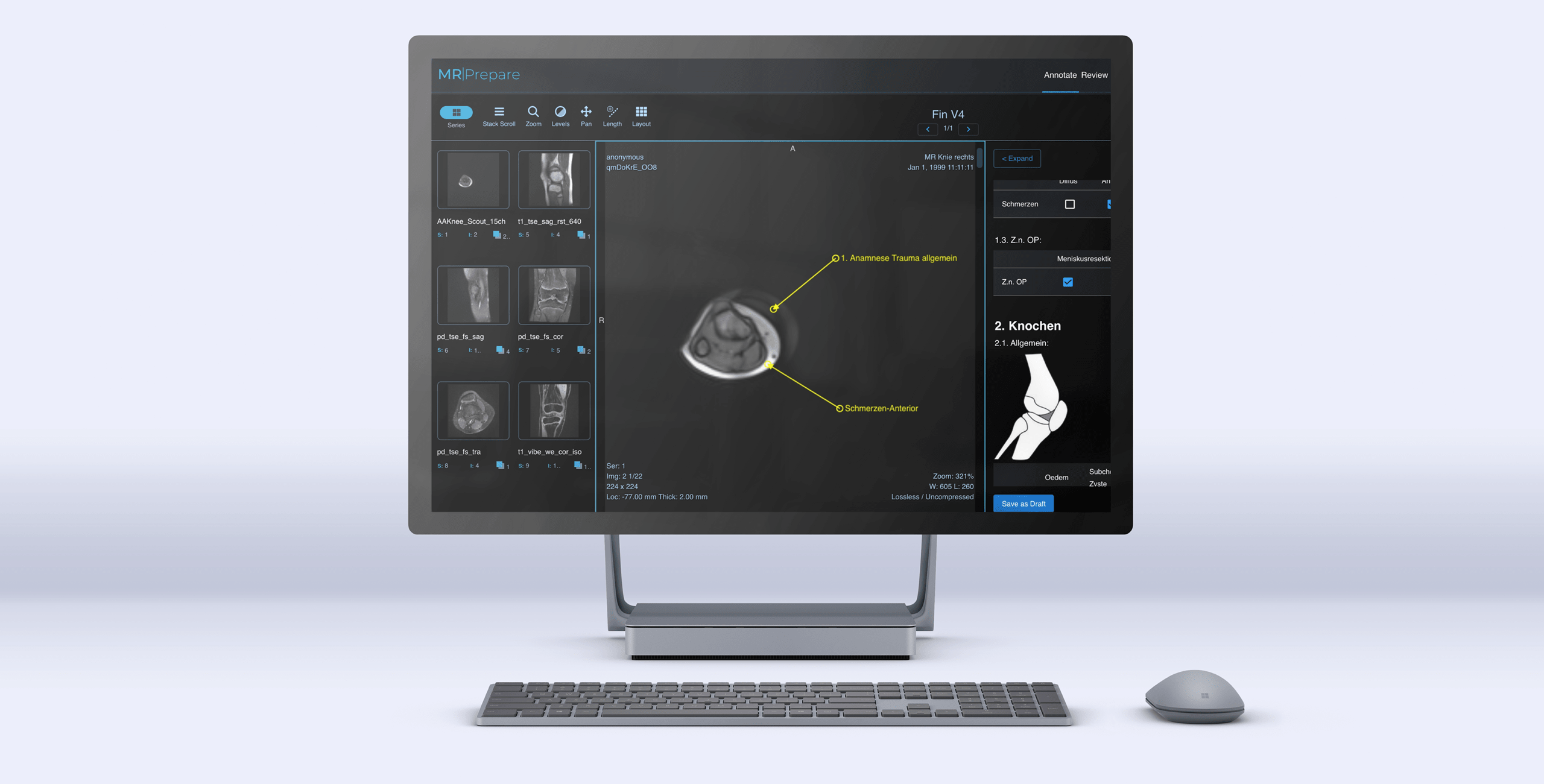
A medical imaging annotation platform that connects radiologists and students to a structured workflow for building labeled DICOM datasets that train AI diagnostic systems.
OHIF, Orthanc, ReactJS, Symfony, PHP, PostgreSQL
Medical imaging AI company (private platform, not publicly accessible)
3 months to MVP, delivered December 2020
Medical imaging AI requires thousands of expert-labeled DICOM files to train. MR Prepare automates that collection pipeline, connecting radiologists and medical students to a structured annotation workflow that produces the labeled datasets AI models need. Building this required integrating two specialized open-source systems (OHIF for viewing, Orthanc for DICOM storage) that were not originally designed to work together.
MR Prepare is an application in the field of medical diagnostics which allows students and medical doctors to annotate medical cases, marking items of interest such as lesions and pathologies and providing related medical data. In this way, a specific pool of annotated medical images is created and stored in a database together with the original medical imagery files.
The platform enables students to recognize pathology through their annotations. The goal is to collect high-quality data which will be used to teach an artificial intelligence system to individually make diagnoses. This will further help medical doctors to make a faster, better, and more accurate diagnosis, improving patients' medical treatment in a timely manner and saving patients' lives.
Integrating specialized medical imaging systems that were never designed to work together.
Customizing the pre-selected DICOM (OHIF) viewer and the industry-specific Orthanc database required deep integration work. We successfully integrated the internal PostgreSQL database with Orthanc and enabled the system to function as a whole. Translating medical domain language into technical specifications and vice versa built a strong synergy between our two domains.
The aggressive 3-month timeline required a specific approach to project management. We defined and prioritized requirements for the entire project at the very onset, jointly cut out the first viable solution (MVP), and agreed on the steps to follow. The defined scope did not prevent the agile process of learning, changing existing requirements, and creating new ones during development.
The greatest challenge was the integration with third-party solutions and their adaptation to the Partner's needs. We performed mathematical modelling and metrics to find needed deviations using medicine-specific systems. At this point, our two domains got completely intertwined. Working closely together with our Partner, we managed to effectively find and implement the solution.
The team had to acquire knowledge using previously unknown libraries and systems. OHIF and Orthanc are specialized tools with limited documentation outside the medical imaging community. Our engineers invested significant time understanding DICOM file structures, medical imaging workflows, and the regulatory context of healthcare data before writing production code.
We started working on this project in August 2020, with a timeline of 3 months for the initial MVP version. Our Partner needed the product to be developed swiftly and efficiently. During the first few weeks, we thoroughly investigated the project domain of medical imagery and the selected services: DICOM files, the OHIF viewer, and the Orthanc database. We agreed to maximize the benefit of the given time frame by identifying the highest-impact features and cutting out the MVP version accordingly.
After several sprints of intensive work, we had the first version of the complete flow in our hands. Together with the Partner, we took time to thoroughly test it, mutually share our feedback and suggestions, and agree on the priorities.
We delivered the MVP in December 2020 on the agreed timeline. The platform successfully went live, enabling the Partner to begin building their annotated DICOM dataset for AI training. After the initial release, we continued planning the next steps for Version 1, enhancing the solution with additional annotation tools and improved data aggregation features.
What shipped, and what it enabled for the client.
The MVP was delivered in 3 months as agreed, going live in December 2020. The platform integrated the OHIF viewer and Orthanc DICOM server with a custom PostgreSQL synchronization layer, enabling real-time annotation across multiple media types within a single medical case.
The Partner gained a reliable, scalable solution for aggregating medical data for AI training, capable of processing large volumes of DICOM imagery. The structured annotation workflow meant labeled datasets could be produced consistently, with medical professionals working through a standardized interface rather than ad-hoc tools.
MVP delivered on the agreed timeline, from kickoff in August to release in December 2020
Open-source medical imaging systems integrated: OHIF viewer and Orthanc DICOM server, unified via custom PostgreSQL synchronization
Full DICOM pipeline handling medical imagery annotation, storage, and labeled dataset export for AI training
Welcome to the backstage. Got any questions? Drop us a line, we are there for you.
Tell us about your product idea or your team's capacity gap. We'll outline the right approach for your situation.
Request a Free ConsultationFull-stack rebuild of a SaaS virtual mailbox platform for distributed businesses.